Why Testing Mine Slot in Demo Mode Matters
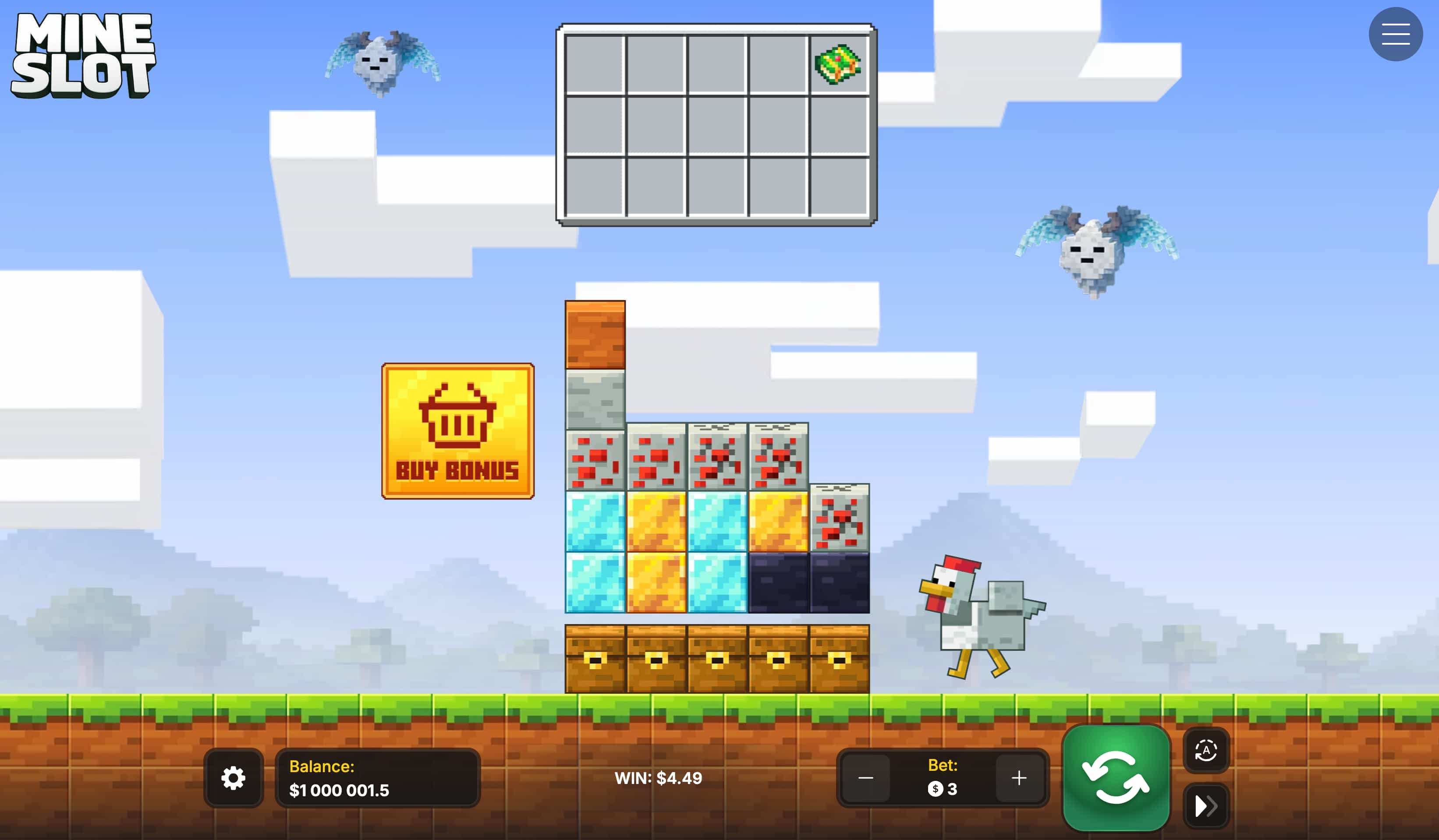
Mine Slot is not a conventional slot. Its dual-layer structure — where reel results feed into a block-destruction field — introduces mechanics that most slot players have never encountered before. Jumping straight into real-money play without understanding how pickaxes interact with blocks, how column clearance works, or how multipliers stack could lead to confusion and premature frustration. The demo exists precisely to eliminate that learning curve at zero financial cost.
Playing the demo allows newcomers to observe the game's pacing firsthand. They can see how often different pickaxe types appear on the reels, how many spins it typically takes to clear a column from top to bottom, and how the field behaves when multiple strong tools land in the same column simultaneously. This kind of pattern recognition is difficult to develop from reading descriptions alone — it requires hands-on experience, and the demo provides exactly that without any downside risk.
Beyond pure mechanics, the demo is also valuable for calibrating expectations around the game's volatility. Mine Slot does not distribute small wins on every spin the way some low-volatility slots do. Instead, its reward structure is concentrated around chest openings — moments that may take several spins to trigger but can deliver substantial multiplied payouts when they arrive. Understanding this rhythm in demo mode helps players make more informed decisions about their bet sizing and session length when they eventually transition to real play.
Finally, the demo serves as a practical device-compatibility check. Players can verify that the game loads smoothly, renders correctly, and responds to touch or click inputs without lag on their specific phone, tablet, or desktop setup. There is no better way to evaluate mobile performance than running a few dozen spins in the actual game environment.
Full Feature List Available in the Demo Version
- Complete 5×3 reel mechanics — all four pickaxe types (wooden, stone, golden, enchanted) appear on the reels with the same distribution logic as the real-money version, giving players an accurate picture of how frequently each tool type lands
- Fully functional 5×7 block field — the mining grid operates identically in demo mode, with all six block types (dirt, stone, ore, gold, diamonds, obsidian) present and their durability values unchanged from the paid version
- Chest multiplier system — clearing a column in demo mode opens the chest at its base, revealing multipliers from 2× through 100×, and multiple chests opened in the same round still multiply together rather than adding
- Free spins bonus activation — the bonus round triggers under the same conditions as in real play, with the critical persistent-field mechanic intact, allowing players to experience the full power of accumulated block destruction across consecutive free spins
- Unlimited virtual balance — the demo provides a replenishable virtual bankroll, removing any pressure to conserve funds and encouraging experimentation with different bet sizes and strategies
- Cross-platform interface — the demo runs on the same HTML5 engine as the real game, meaning the layout, animation quality, and control responsiveness are identical whether accessed from a desktop browser, an Android phone, or an iOS device
Demo vs Real Money — Side-by-Side Comparison
| Aspect |
Demo Mode |
Real Money Mode |
| Player balance |
Virtual credits with no monetary value — replenished automatically when depleted |
Real funds deposited through a casino account, with all wins and losses affecting the player's actual balance |
| Game mechanics |
Identical to real play — same reel probabilities, block durabilities, pickaxe behaviors, and multiplier distributions |
Identical to demo — the underlying math model and RNG produce equivalent results across both modes |
| Chest multipliers |
Full range available (2× through 100×) with the same multiplicative stacking rule |
Full range available with real monetary impact on every chest opening |
| Account requirement |
None — accessible without registration, email verification, or any personal data submission |
Requires a verified account at a licensed online casino that offers InOut Games products |
| Withdrawable winnings |
Not applicable — virtual credits cannot be converted to real money or transferred |
Winnings can be withdrawn according to the casino's payout policies and applicable wagering requirements |
Getting Started — Step-by-Step Demo Launch
- Navigate to the demo page — open the Mine Slot demo through the provider's official site or any casino platform that hosts the free-play version, no account creation necessary
- Wait for the browser to load the game — Mine Slot is built on HTML5 and launches directly in-browser, so there is no application to install, no plugin to enable, and no file to download regardless of your operating system
- Adjust the virtual bet amount — use the on-screen controls to set your preferred stake level, experimenting freely since the balance is entirely virtual and carries no financial consequence
- Press the spin button and observe the full cycle — watch the reels stop, see which pickaxes land, follow their descent into the mining field, note which blocks are damaged or destroyed, and check whether any columns are cleared enough to open a chest
Structuring Your Demo Sessions for Maximum Learning
The most productive approach to demo play is structured experimentation rather than aimless spinning. Consider dividing your demo time into three distinct phases, each with a specific focus. In the first phase — roughly the first thirty spins — concentrate entirely on understanding the interface. Learn where the bet controls are, how the spin button works, where the mining field displays relative to the reels, and how the game communicates results. Do not worry about strategy or payout patterns during this phase; the goal is pure mechanical familiarity.
In the second phase — spins thirty through one hundred — shift your attention to the block field. Watch how different pickaxe types interact with different block materials. Notice which columns are progressing faster and try to understand why. Observe the durability indicators for each block type and develop a sense for how many hits each material requires to break. This is the phase where you build the spatial awareness that makes real-money play more engaging and less confusing.
In the third phase — spins one hundred and beyond — focus on outcomes. Track how often chests actually open, what multiplier values appear, and how the multiplicative stacking works when multiple chests trigger. If a free spins bonus activates during this phase, pay especially close attention to how the persistent field transforms the bonus round from a series of isolated spins into a continuous excavation sequence. By the time you complete this phase, you should have a clear, experience-based understanding of Mine Slot's rhythm that no written guide can replicate.
What Deserves Your Attention During Demo Sessions
Not all spins in Mine Slot are created equal, and the demo is the best place to develop an intuition for which moments matter most. Rather than spinning mindlessly, players who pay attention to specific patterns will extract far more value from their demo time. The goal is not to "win" in demo mode — it is to build a mental model of the game that translates into smarter decisions during real play.
- Pickaxe distribution patterns — track how often wooden versus enchanted pickaxes appear across your demo session; this gives you a realistic sense of how frequently the game delivers high-impact tools versus filler spins that barely scratch the surface
- Column clearance frequency — count how many spins it takes, on average, to fully clear a single column from top to bottom; this number is crucial for estimating how many spins a real-money session should be budgeted for if chest openings are the primary goal
- Multiplier stacking in action — when two or more chests open in the same round, note the combined multiplier and compare it to what you would have received if the values had merely been added; this visceral demonstration of multiplicative math is what makes multi-column clearance so powerful
- Free spins field behavior — pay close attention to how the persistent field changes the game during bonus rounds; observe how damage accumulates across spins and notice the moment when accumulated progress suddenly tips a column into clearance
These observations form the foundation of informed play. A player who has spent thirty minutes in demo mode watching these patterns will approach real-money sessions with a qualitatively different understanding than someone who simply read a feature list and jumped in.
Running the Demo on Phones and Tablets
Mine Slot's demo version performs identically on mobile devices as it does on desktop computers. The game's HTML5 architecture ensures that the same code runs in any modern mobile browser — Chrome, Safari, Firefox, or their equivalents — without requiring a dedicated app download. The interface automatically adjusts to the screen dimensions of the device, rendering the 5×3 reel grid and the 5×7 block field in a vertically stacked layout that works naturally in portrait orientation.
Touch controls have been calibrated for finger input rather than cursor precision. The spin button, bet adjustment controls, and menu toggles are all sized to accommodate typical tap zones, reducing the risk of accidental inputs. Animations play smoothly on modern mid-range devices, and the game has been optimized to avoid excessive battery drain during extended demo sessions. For players who intend to play the real-money version primarily on their phone, running the demo on the same device first is the most reliable way to confirm that the experience meets their expectations for speed, clarity, and responsiveness.
One practical advantage of mobile demo play is portability. Players can test Mine Slot during commutes, breaks, or any idle moment without needing access to a desktop computer. This low-friction accessibility makes it easy to accumulate demo experience in short bursts, gradually building familiarity with the game's mechanics across multiple brief sessions rather than requiring a single long desktop sitting.
Understanding Mine Slot Volatility Through Demo Play
One of the most valuable lessons the demo teaches is how Mine Slot's volatility actually feels in practice. Reading that a game has "medium-to-high volatility" is abstract. Experiencing thirty spins where the field barely changes, followed by two consecutive spins where an enchanted pickaxe blasts through a column and opens a chest — that is concrete. The demo lets players calibrate their emotional response to these swings without any financial consequences. Some players discover that they genuinely enjoy the long build-up followed by a dramatic payoff. Others realize that the extended quiet periods between chest openings do not suit their temperament. Either conclusion is valuable, and arriving at it through free play rather than after spending real money is the entire point.
The demo also reveals how the game's two layers interact over time. In a short session — say, five or ten spins — the mining field may appear frustratingly static. But over fifty or a hundred spins, patterns emerge. Players begin to see how blocks accumulate damage across multiple spins even in the base game (where the field resets, but the visual feedback still trains intuition), and they start developing a sense for which column configurations are close to clearing. This spatial awareness translates directly into engagement during real-money play, where recognizing a nearly-cleared column adds tension and excitement to every spin.
Common Mistakes to Avoid in Demo Mode
While the demo carries no financial risk, players can still waste their demo time by approaching it with the wrong mindset. The most common mistake is treating the demo as entertainment rather than as a learning tool. Spinning rapidly without paying attention to the field, ignoring which pickaxe types produce meaningful results, or closing the game after a few spins because nothing dramatic happened — these behaviors prevent players from extracting the insights that make the demo worthwhile. The second mistake is drawing statistical conclusions from tiny sample sizes. A demo session of twenty spins is not enough to understand Mine Slot's payout distribution. Players who happen to open two chests in their first ten demo spins may develop unrealistic expectations about chest frequency. Conversely, players who go forty spins without a chest opening may unfairly conclude that the game is stingy. Neither impression is accurate — both are artifacts of short-term variance that smooth out over longer sessions. A minimum of one hundred demo spins is a reasonable baseline for forming reliable impressions about the game's rhythm and reward frequency.
A third pitfall is ignoring the free spins bonus when it triggers during demo play. Some players dismiss bonus rounds in demo mode as meaningless because no real money is at stake. In reality, the free spins round is where Mine Slot's most distinctive mechanic — the persistent field — comes alive. Observing how block damage carries over between consecutive free spins, and seeing how this accumulation eventually tips columns into clearance, is essential preparation for real-money play. Players who skip or rush through demo free spins miss the game's most important feature.
How Many Demo Spins Are Enough
There is no universal answer to this question, but there are useful benchmarks. A session of twenty to thirty spins is sufficient to understand the basic controls, interface layout, and the visual flow of pickaxes dropping into the block field. This is enough for a first impression but far too little for evaluating the game's reward structure or volatility pattern. A session of one hundred spins provides a much more reliable picture. By this point, a player will have seen multiple pickaxe types in action, observed how different block materials respond to different tool strengths, and likely experienced at least one or two chest openings that demonstrate the multiplier system. For players who want to be thorough — particularly those planning to play with significant real-money stakes — two hundred or more demo spins is ideal. This extended experience is especially valuable for observing the free spins bonus, which may trigger only a few times across a two-hundred-spin session, giving the player a realistic expectation of bonus frequency.
The key insight is that demo play is an investment of time, not money. The returns on that investment — in the form of game knowledge, mechanical intuition, and calibrated expectations — are directly proportional to the number of spins played. A player who rushes through twenty demo spins and declares themselves ready for real play is like a student who reads the table of contents and claims to have finished the book. The substance is in the details, and the details reveal themselves over sustained engagement.
Practical Advice Before Moving to Real Stakes
- Calculate your session budget in spins, not dollars — before depositing, divide your intended budget by your planned bet size; a healthy session length for Mine Slot is roughly 150 to 250 spins, which gives the game's concentrated reward structure enough room to breathe and produce meaningful chest-opening moments
- Establish exit points before you begin — set a profit target (commonly between +30% and +80% of your starting balance) and a loss limit (typically between −25% and −40%); these boundaries sound restrictive, but they are the structural difference between sessions that end on the player's terms and sessions that end when the bankroll does
- Resist the urge to chase losses with larger bets — Mine Slot's volatility means that dry stretches are a normal part of the experience, not a signal that a big win is imminent; increasing your stake during a cold run is the fastest way to exhaust a bankroll without any compensating upside
- Treat chest openings as fortunate events, not expected outcomes — the demo will show you that chests do not open on every spin or even every few spins; approaching real play with the expectation that chests are bonuses rather than entitlements prevents the emotional tilt that leads to poor betting decisions
- Take breaks and play responsibly — fast-paced games on small screens can make time disappear; setting a timer for 10 to 15 minutes per session helps keep the experience in the entertainment zone and prevents fatigue-driven mistakes