Company Background — Who InOut Games Are
InOut Games operates under the legal entity IOGr B.V., incorporated in Curaçao with a registered address at Julianaplein 36, Willemstad. The company holds a gaming license issued by the government of the Autonomous Island of Anjouan, part of the Union of Comoros, under license number ALSI-202506032-FI2. This license authorizes InOut Games to function as a B2B gaming provider, developing and distributing casino games to operators rather than running player-facing casino platforms directly.
The company's operational model is straightforward: InOut Games builds the games, and licensed casino operators host them. This B2B structure means that players encounter InOut Games titles through third-party casinos rather than on a proprietary InOut-branded gambling site. Integration is available either through aggregator platforms — which bundle games from multiple providers into a single API for operators — or through direct partnerships with individual casino brands. This flexibility allows InOut Games to reach a broad operator network without maintaining the infrastructure required to serve end users directly.
From a regulatory standpoint, the company states that it has passed all compliance checks required by its licensing authority and is legally authorized to conduct gaming activities as a provider. While the Anjouan license is not among the most widely recognized in the industry (compared to Malta or the UK, for instance), it does represent a formal regulatory framework that imposes baseline requirements on the provider's operations, including game fairness and responsible gaming obligations.
What InOut Games Specializes In
The studio's identity was forged in the crash game space. Crash games are a relatively recent addition to the online casino landscape — fast-paced formats where a multiplier rises continuously until it randomly crashes, and the player must decide when to cash out. The appeal of these games lies in the feeling of agency: the player is not passively watching reels spin but actively making decisions that determine the outcome. Chicken Road, InOut Games' most recognized title, epitomizes this philosophy. The player guides a character across a grid, choosing a path at each step, with the risk of elimination increasing as the journey progresses.
This emphasis on player involvement became the studio's defining characteristic. Unlike traditional slot developers who focus on payline combinations and bonus reel features, InOut Games consistently gravitated toward formats where the player feels directly responsible for the result. The games are quick to learn, fast to play, and built around a transparent risk-reward dynamic that keeps players engaged through a combination of tension and perceived control.
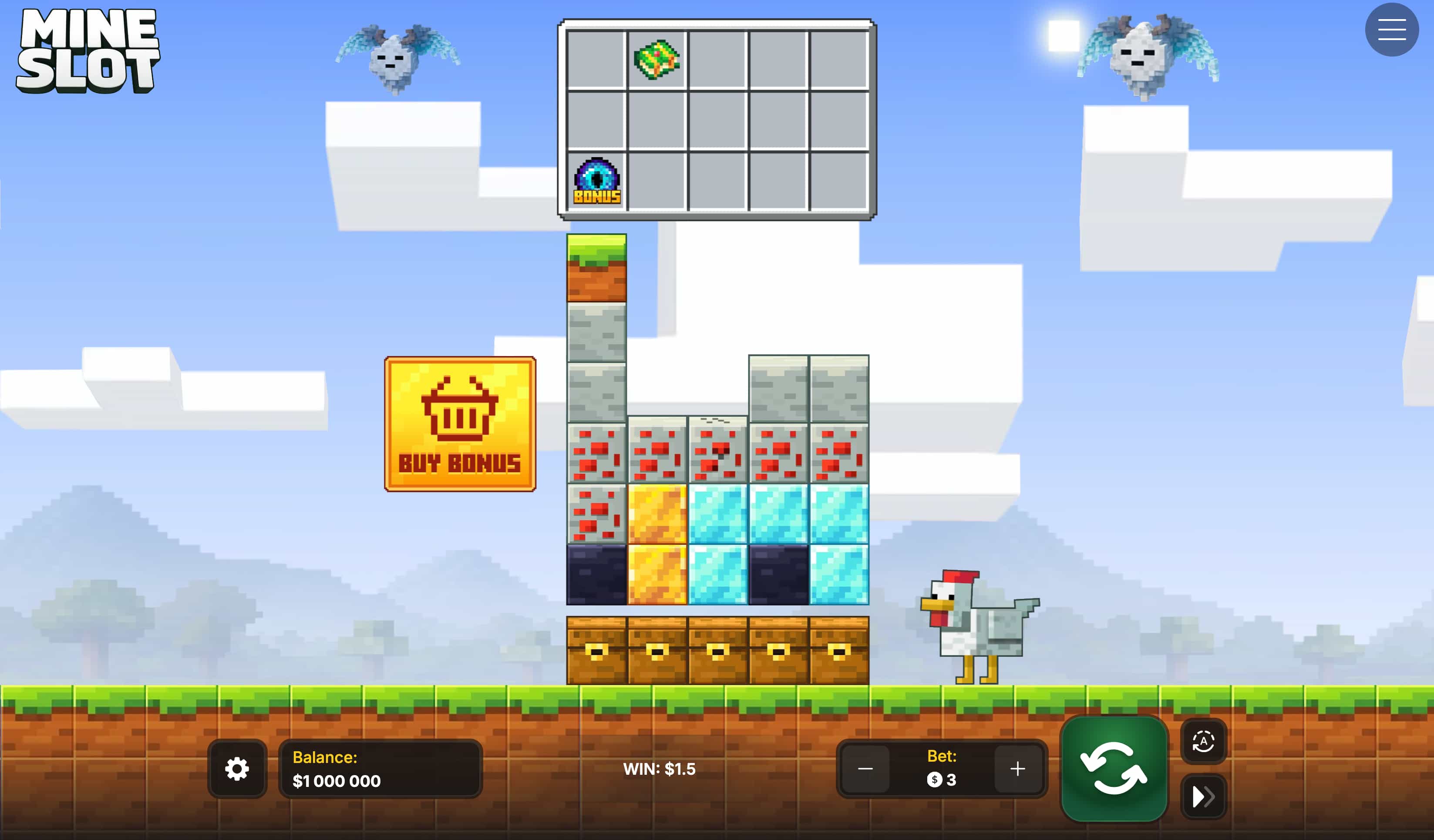
Mine Slot represents a conscious departure from — and simultaneously an extension of — this heritage. It is structurally a slot, which means the player presses spin and observes the outcome rather than making in-round decisions. But the block-field mechanic layered beneath the reels introduces a form of visible progress that echoes the step-by-step advancement found in crash games. Each spin adds to (or fails to add to) the excavation of the mining field, creating a narrative arc across multiple rounds that feels more like a journey than a series of isolated events. In this sense, Mine Slot translates the emotional core of InOut Games' crash titles into a slot wrapper — sacrificing direct player control but preserving the sense that each round contributes to a larger, ongoing story.
Game Library — Notable Titles From InOut Games
| Game Name |
Category |
Distinguishing Mechanic |
| Chicken Road |
Crash / Path game |
Player-directed movement across a risk grid, with each step increasing both the multiplier and the chance of elimination. The game that established InOut Games' reputation for interactive, decision-driven casino formats. |
| Chicken Royal |
Slot |
The studio's first experiment with reel-based mechanics. Served as a proof of concept for InOut Games' entry into the slot market, testing whether the studio's audience and operator partners would accept a less interactive format from a crash-game developer. |
| Mine Slot |
Hybrid slot with mining field |
Combines a 5×3 reel grid with a 5×7 block-destruction field. Pickaxes from the reels drop into columns and break blocks of varying durability, with fully cleared columns opening chests that contain multipliers up to 100×. |
| Additional crash / instant-win titles |
Instant-win / crash |
Fast-round formats with immediate outcomes, designed around visible multiplier growth and player-timed cash-out decisions. These titles form the backbone of InOut Games' portfolio and account for the majority of the studio's market presence. |
| Upcoming releases |
Various formats |
InOut Games continues expanding its library with new titles that explore both familiar crash-game territory and further experimentation in the slot segment, building on the hybrid foundation laid by Mine Slot. |
Technical Foundation and Integration Options
- HTML5 development — every game in the InOut Games catalog is built using HTML5 technology, which means titles run directly in web browsers on any device without requiring Flash, Java, or native app installations
- Cross-platform compatibility — games are tested and optimized for desktop monitors, smartphones, and tablets, with responsive layouts that adapt to different screen sizes and orientations automatically
- Operator integration paths — casinos can add InOut Games titles either through aggregator platforms (which provide a single API connection to multiple providers simultaneously) or through direct integration partnerships with the studio
- Language coverage — the game suite supports more than 15 languages out of the box, enabling operators to serve diverse international markets without needing to commission separate localizations
- Provably fair capability — where the hosting operator supports it, InOut Games titles can operate with provably fair verification, allowing players to independently verify that game outcomes were generated fairly through cryptographic proof
Regulatory Status and Licensing Details
InOut Games holds its operating license from the Anjouan Gaming Board, the regulatory authority for gaming activities on the Autonomous Island of Anjouan within the Union of Comoros. The license number is ALSI-202506032-FI2, and the company has completed the regulatory compliance process required to receive and maintain this authorization. Under this license, InOut Games is permitted to develop and distribute casino games to third-party operators as a B2B provider.
The Anjouan Gaming Board is a relatively newer entrant among international gaming regulators. It does not carry the same global recognition as authorities like the Malta Gaming Authority, the UK Gambling Commission, or the Isle of Man Gambling Supervision Commission. However, it imposes its own set of standards regarding game integrity, responsible gaming practices, and operational transparency. For players and operators evaluating InOut Games, the existence of a formal license means that the studio has submitted to external oversight and is accountable to a regulatory body — a baseline that unregulated providers do not offer.
The company's registered entity, IOGr B.V., is incorporated in Curaçao, which provides the corporate legal framework under which the business operates. This dual-jurisdiction structure — Curaçao incorporation with Anjouan gaming licensing — is not uncommon in the B2B gaming industry, where companies often separate their corporate registration from their gaming authorization based on operational and regulatory considerations.
What Sets InOut Games Apart From Larger Studios
- Niche focus over volume — while major providers like Pragmatic Play, NetEnt, or Microgaming release dozens or even hundreds of titles per year, InOut Games maintains a deliberately compact catalog; each game receives concentrated development attention rather than being one entry in a mass-production pipeline
- Engagement through mechanics, not just themes — many large studios differentiate their slots primarily through visual themes (ancient Egypt, fantasy kingdoms, fruit machines), while InOut Games differentiates through unusual gameplay mechanics that create fundamentally different player experiences
- Crash-game heritage as a design lens — the studio's background in interactive, decision-driven formats influences how it approaches even passive-observation games like slots; Mine Slot's block-field progression is a direct descendant of the step-by-step tension found in Chicken Road
- Willingness to experiment across genres — the move from crash games to hybrid slots represents a genuine creative risk; InOut Games is not simply reskinning a proven template but attempting to create new gameplay categories that bridge traditionally separate formats
Comparative Positioning — InOut Games vs Industry Norms
| Dimension |
InOut Games Approach |
Typical Large Provider Approach |
| Portfolio size |
Compact and curated — a small number of titles, each with distinctive mechanics |
Expansive — hundreds of titles spanning slots, table games, live dealer, and more |
| Primary genre |
Crash games and hybrid instant-win formats with recent expansion into slots |
Traditional reel-based slots as the core revenue driver, supplemented by table games and live casino |
| Player engagement model |
Emphasis on perceived interactivity, visible progression, and player-involved tension |
Emphasis on visual spectacle, branded content, and feature-rich bonus rounds |
| Strategic positioning |
Niche innovation — targeting players and operators looking for something mechanically different |
Mass-market coverage — serving the broadest possible audience with recognizable formats |
This comparison is not a value judgment. Large providers serve an essential market function by offering reliable, well-tested content at scale. InOut Games occupies a different ecological niche — one defined by creative risk-taking, mechanical experimentation, and a willingness to serve a smaller audience with products that genuinely feel different from the industry mainstream. Both approaches have commercial validity; they simply target different operator needs and player preferences.
Design Philosophy — How InOut Games Builds Its Products
The thread connecting all InOut Games titles is a commitment to what might be called "mechanical storytelling." Rather than relying on narrative cutscenes, branded intellectual property, or elaborate visual themes to hold player attention, the studio builds engagement through the gameplay mechanics themselves. In Chicken Road, the story is told through each step the player takes — will the next tile be safe or deadly? In Mine Slot, the story unfolds as the mining field gradually transforms from a solid wall of blocks into a partially excavated landscape with visible paths toward the buried chests. The drama is structural, not decorative.
This philosophy has practical implications for how the studio allocates its development resources. Where a theme-driven developer might invest heavily in animation, sound design, and cinematic bonus introductions, InOut Games channels effort into the behavioral logic of the game itself — the math model governing how pickaxes interact with blocks, the probability distribution of chest multipliers, the precise calibration of block durability across the field's layers. The visual presentation is clean and effective (the pixel-art style in Mine Slot is immediately appealing), but it serves the mechanics rather than the other way around.
For operators evaluating InOut Games as a content partner, this design approach has measurable consequences for player behavior. Games built around mechanical engagement tend to produce different session patterns than theme-driven slots. Players who connect with the underlying mechanics often play longer sessions, return more frequently, and show higher tolerance for volatility — because they understand the game's rhythm and are playing toward specific mechanical outcomes (like clearing a column) rather than simply hoping for random bonus triggers. This difference in player behavior can influence retention metrics and lifetime value in ways that matter to data-driven casino operators.
Market Context — Where InOut Games Fits in the Provider Landscape
The online casino content market is dominated by a small number of large providers who collectively supply the majority of games found in operator lobbies worldwide. Studios like Pragmatic Play, Evolution, NetEnt, Play'n GO, and Microgaming maintain enormous catalogs that span every conceivable game category and visual theme. For operators, these providers offer safety and completeness — a single integration can fill an entire lobby with hundreds of tested, proven titles. For players, they provide familiarity — recognizable game brands that appear consistently across different casino platforms.
InOut Games does not compete in this arena and does not attempt to. The studio positions itself as a specialty provider — a source of content that fills gaps left by the generalist giants. The specific gap InOut Games targets is the demand for mechanically novel, engagement-driven formats that feel genuinely different from the industry's dominant templates. Crash games were the initial expression of this positioning, and the expansion into hybrid slots like Mine Slot extends it into a new category without abandoning the core principle.
For operators, adding InOut Games to a lobby is not about replacing a major provider — it is about diversifying the content mix with titles that attract and retain a specific player segment. Players who gravitate toward InOut Games products tend to be those who have grown fatigued with conventional slot formats and are actively seeking something mechanically fresh. These players represent a valuable audience segment, and serving them requires content that mainstream providers do not typically produce.
Player Experience — What InOut Games Feels Like From the Other Side
From a player's perspective, InOut Games titles share a common feel that distinguishes them from the broader slot market. The games tend to resolve quickly — individual rounds do not feature lengthy cutscene animations or multi-stage bonus introductions. The visual communication is direct — it is always clear what happened on a given spin and why. And the risk-reward dynamic is transparent — players can see, rather than just theorize about, the relationship between their actions (or in Mine Slot's case, their reel outcomes) and the resulting payouts.
This transparency is a deliberate design choice that reflects the studio's crash-game heritage. In crash games, the multiplier is visible on screen at all times, rising in real time. The player knows exactly what they stand to win at every moment and must decide when to stop. Mine Slot translates a version of this transparency into slot form: the block field is always visible, the durability of each block is implied by its material type, and the chests at the bottom represent a clear, visible goal that the player can track progress toward. There is no hidden mechanic, no obscure bonus trigger condition, and no payout table that requires a mathematics degree to interpret.
For players accustomed to the often opaque mechanics of modern video slots — where bonus features trigger based on invisible internal states and payout calculations happen behind curtains of animated graphics — this directness can feel refreshing. It creates a relationship between the player and the game that is based on comprehension rather than hope. The player understands what is happening, why it is happening, and what needs to happen next for a meaningful result to occur. This understanding does not change the randomness of the outcomes, but it changes the quality of the player's engagement with those outcomes.
Looking Ahead — InOut Games' Trajectory
The release of Mine Slot signals a strategic inflection point for InOut Games. Having established credibility and audience loyalty through crash games and instant-win formats, the studio is now testing whether its design philosophy can translate successfully into broader casino game categories. The slot market is enormous — far larger than the crash-game niche — and a successful slot offering could dramatically expand InOut Games' addressable market without requiring the studio to abandon its core identity.
The early reception of Mine Slot suggests that there is genuine demand for the type of mechanical innovation InOut Games brings to the table. The game has attracted attention precisely because it does not feel like another reskinned slot from a catalog of hundreds. Whether the studio continues to develop hybrid slot concepts, returns to its crash-game roots, or explores entirely new format categories, the trajectory is clear: InOut Games is positioning itself as a studio that refuses to build generic products, even as it expands into mainstream gaming categories. For operators and players watching the provider landscape for emerging studios worth tracking, InOut Games has earned a place on the shortlist.