What Draws Players to Search for Mine Slot Alternatives
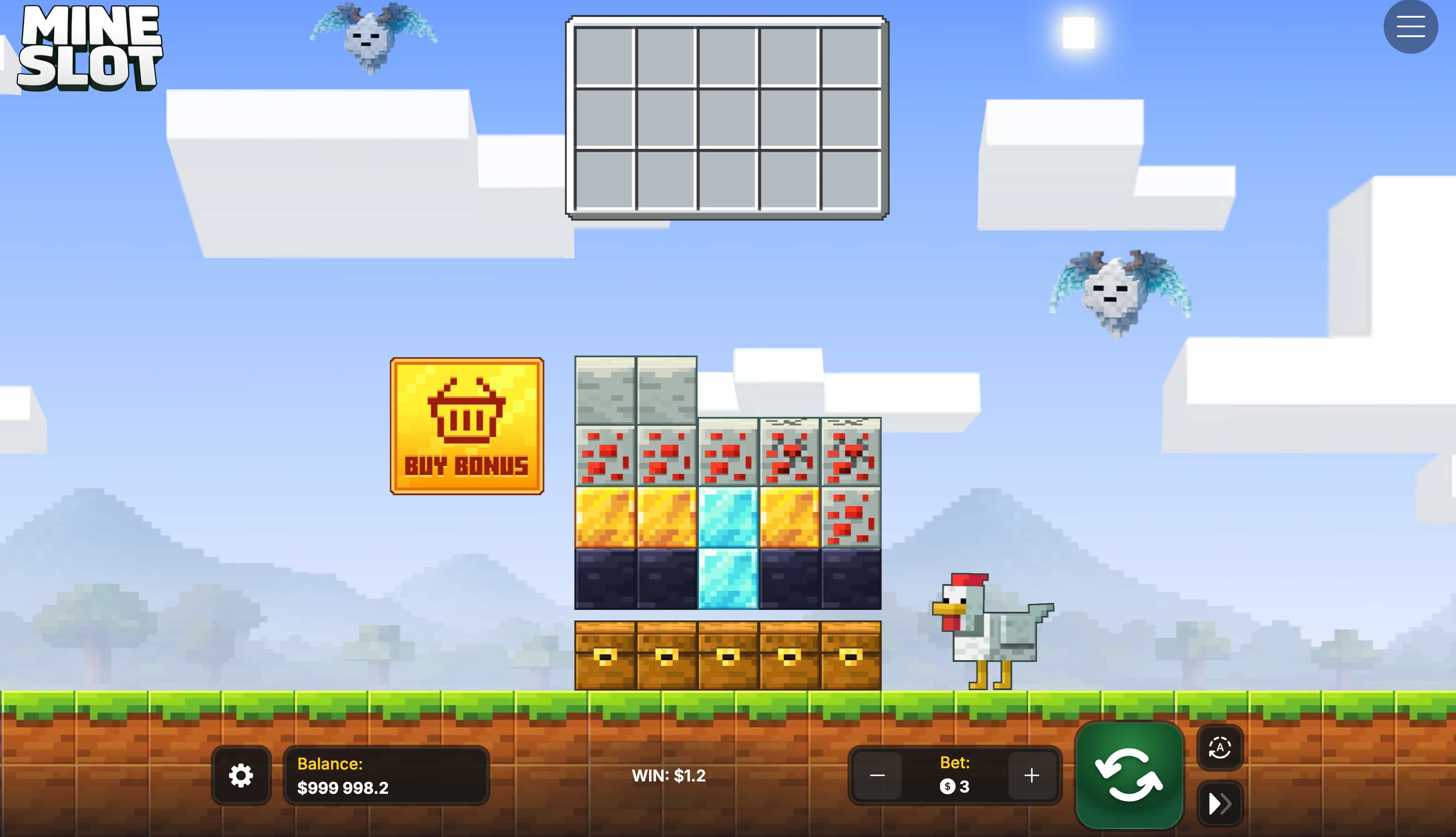
The appeal of Mine Slot is not one-dimensional, and understanding what specifically attracted a player helps narrow the search for suitable alternatives. Some players are drawn primarily to the Minecraft-flavored pixel art — the blocky terrain, the pickaxe tools, the satisfying visual of blocks shattering layer by layer. Others are more interested in the mechanical structure: the dual-layer gameplay where reels feed tools into a secondary field, creating a progression system that spans multiple spins. A third group may care most about the multiplier math — specifically the multiplicative stacking of chest rewards, which creates the potential for outsized payouts when multiple columns clear simultaneously.
Each of these attraction points leads to a different set of alternatives. A player chasing the Minecraft aesthetic will find value in pixel-art casino games regardless of their underlying mechanics. A player seeking the two-phase gameplay structure should look at slots with cascading grids, cluster mechanics, or persistent bonus fields. And a player focused on multiplier stacking will want to explore games from any theme that feature compounding multiplier systems in their bonus rounds. The sections below address each of these categories individually.
Direct Mechanical Relatives — Block and Mining Slot Formats
| Game Title |
Developer |
Connection to Mine Slot |
| Minedrop |
Paperclip Gaming |
The conceptual predecessor to Mine Slot. Minedrop introduced the block-mining mechanic into a casino format and remains a Stake.com exclusive. Players who want to experience the original version of this gameplay concept will find it here, though availability is limited to a single platform. |
| Classic Mines (various versions) |
Multiple providers |
Mines is an instant-game format where players select tiles on a grid, revealing either gems or hidden traps. The grid-based structure and risk-per-step tension share DNA with Mine Slot, but Mines lacks reel mechanics entirely — it is a pure choice-driven instant game, not a slot hybrid. |
| Cluster and cascade slots |
Various (e.g., Play'n GO, Push Gaming) |
Slots with grid-based mechanics where matching symbols are destroyed and replaced by new ones falling from above. The "destruction and replacement" loop echoes Mine Slot's block-breaking field, though the underlying trigger (symbol matches vs. pickaxe hits) differs fundamentally. |
| Drilling and excavation themed slots |
Various providers |
A small category of slots built around the visual metaphor of digging deeper into the earth. These games share Mine Slot's surface-to-depth progression narrative, though most implement it through bonus rounds rather than as a persistent field mechanic. |
Pixel-Art Casino Games With a Minecraft Flavor
The Minecraft aesthetic has a powerful nostalgic pull that extends well beyond the gaming community. Its blocky visual language — voxel-style terrain, pixelated tools, earth-tone color palettes — has become a cultural shorthand for exploration, building, and discovery. Casino game developers have recognized this appeal and produced several titles that borrow elements of the Minecraft visual identity, though the degree of mechanical similarity to Mine Slot varies widely across these products.
Players searching specifically for the Minecraft look and feel in a casino context should consider three distinct sub-categories within this space:
- Games with pixel-art block visuals — titles that adopt the chunky, voxel-inspired art style characteristic of Minecraft, rendering symbols, backgrounds, and animations in deliberately low-resolution pixel graphics that evoke the sandbox game's handcrafted charm
- Games with resource-mining progression — casino products where the gameplay involves collecting materials of ascending rarity and value, mirroring Minecraft's progression from dirt and stone through iron, gold, and diamond tiers
- Games with depth-based reward escalation — titles where moving deeper into a field, grid, or layered structure unlocks increasingly valuable rewards, replicating the Minecraft principle that the best resources are found furthest underground
It is worth noting that visual similarity does not guarantee mechanical similarity. A slot dressed in Minecraft-style graphics but running on conventional payline mechanics will feel very different from Mine Slot in actual play. Players who prioritize the gameplay experience over the visual theme should weigh mechanical structure more heavily than art style when evaluating alternatives.
More From InOut Games — The Studio's Other Titles
| Title |
Format |
What It Shares With Mine Slot |
| Chicken Road |
Crash / path game |
Built by the same developer, Chicken Road delivers a step-by-step progression format where each move increases both risk and reward. The pacing and tension arc are similar to Mine Slot's column-clearing journey, though Chicken Road gives the player direct control over each decision rather than relying on reel outcomes. |
| Chicken Royal |
Slot |
As InOut Games' first slot release, Chicken Royal serves as the mechanical precursor to Mine Slot. It established the studio's approach to reel-based content and tested whether InOut Games' crash-game audience would accept a less interactive format. Players curious about the studio's evolution into slots may find it a useful reference point. |
| Other instant-win games |
Instant-win / crash |
The broader InOut Games catalog includes several fast-round, multiplier-driven titles that share the studio's signature emphasis on quick results, transparent risk mechanics, and player-perceived control. These games do not replicate Mine Slot's block field, but they deliver a similar emotional rhythm of building tension followed by decisive moments. |
Slots That Feature Compounding Multiplier Systems
One of Mine Slot's most distinctive mechanical features is its multiplicative chest stacking — when multiple chests open in the same round, their multipliers are multiplied rather than added together. This creates an exponential scaling potential that turns multi-column clearance from a nice bonus into the primary path toward the game's largest possible payouts. Players who find this multiplicative math exciting will discover that several other slot categories employ similar compounding reward structures, even without the mining theme.
- Cascade multiplier slots — games where each consecutive cascade (symbols being destroyed and replaced within a single spin) increases a running multiplier; the more cascades that chain together, the higher the multiplier climbs, creating a stacking effect that rewards extended winning sequences
- Bonus-round accumulation slots — titles where multipliers collected during a free spins or bonus feature are retained and compounded across the entire bonus duration, so that later spins in the feature are dramatically more valuable than earlier ones
- Persistent-state slots — games that preserve some element of progress between spins, similar to how Mine Slot's free spins mode retains block damage across consecutive rounds; this mechanic creates the same feeling of building toward a payoff over multiple spins rather than resolving everything within a single spin cycle
- Crash games with exponential multipliers — the broader crash-game genre where a multiplier rises continuously until a random stop point, offering players the decision of when to exit; while mechanically different from Mine Slot, the emotional experience of watching a multiplier compound upward shares the same core thrill
The common thread across all of these formats is the principle that rewards grow non-linearly. In a linear payout system, twice the luck produces twice the reward. In a multiplicative system, twice the luck can produce four or ten times the reward. Mine Slot's chest stacking is one implementation of this principle, but it is far from the only one — and players who respond to exponential reward scaling will find plenty of options across different themes and providers.
The Role of Volatility When Comparing Alternatives
Volatility — sometimes called variance — is one of the most important factors to consider when searching for games similar to Mine Slot. Mine Slot has a concentrated payout profile: most spins contribute incremental progress on the block field without producing direct wins, and the big payouts arrive in bursts when chests open. This means long stretches of quiet play punctuated by sudden, potentially large rewards. Players who enjoy this rhythm need alternatives with a similarly concentrated volatility pattern.
Low-volatility slots, which deliver frequent small wins spread evenly across every spin, will feel fundamentally different from Mine Slot regardless of their theme or visual style. A Minecraft-themed slot with low volatility might look like Mine Slot but play nothing like it. Conversely, a high-volatility slot with an ancient Egyptian theme might share almost nothing visually with Mine Slot but deliver an emotionally similar experience — long patience rewarded by dramatic payout spikes. When evaluating alternatives, volatility should weigh at least as heavily as theme or visual style in the decision-making process.
Unfortunately, not all game providers publish explicit volatility ratings, and when they do, the scales are not standardized across the industry. A game labeled "high volatility" by one provider might correspond to "medium-high" on another provider's scale. The most reliable way to assess volatility is through hands-on demo play — spending a hundred or more demo spins observing how often and how large the payouts are relative to the bet size. This empirical approach provides a visceral understanding that no written volatility label can match.
Evaluating Alternatives Through Demo Play
The single best tool for comparing Mine Slot alternatives is the demo mode available for most online slots. Rather than relying on written reviews, screenshots, or marketing descriptions, players should load up the demo version of any potential alternative and play a meaningful session — at least fifty to one hundred spins. During this session, they should pay attention to the same mechanics they evaluated during their Mine Slot demo experience: how often significant events trigger, how the game communicates progress (if at all), how the payout distribution feels in practice, and whether the gameplay loop produces the same kind of engagement they enjoy in Mine Slot.
Comparing demo sessions side by side also reveals differences that descriptions cannot capture. Two games may both be described as "mining-themed slots with multiplier features," but one might resolve each spin in two seconds while the other includes a fifteen-second animation sequence. One might display accumulated progress clearly on screen while the other buries it in a numerical counter. These experiential details dramatically affect whether a game feels like a genuine Mine Slot alternative or merely shares a few surface-level characteristics.
Players should also note how alternatives handle the transition between base game and bonus rounds. Mine Slot's most distinctive feature is the persistent field during free spins — the fact that block damage carries over between consecutive bonus spins. Alternatives that reset all progress at the start of each spin, even during bonus rounds, will feel qualitatively different in their bonus phases. This single mechanic is one of the hardest to replicate and one of the most important to test during comparative demo play.
Picking the Right Alternative — A Decision Framework
- Identify the specific element that appeals most — before browsing alternatives, pinpoint whether it is the Minecraft theme, the block-field mechanic, the dual-layer gameplay, the multiplier stacking, or the InOut Games style that you want to replicate; trying to match everything at once will severely limit options, while focusing on a single axis opens up a much wider field
- If the Minecraft aesthetic is the priority — search for pixel-art and mining-themed slots regardless of their underlying mechanics; these games will deliver the visual and atmospheric experience even if the gameplay loop differs from Mine Slot's two-phase structure
- If the field progression mechanic is the draw — look at cascade-style slots, grid-based mechanics, and games with persistent bonus fields; these formats share Mine Slot's emphasis on cumulative progress across multiple events rather than one-shot payline evaluations
- If multiplier stacking is the main attraction — explore slots with compounding multiplier features in their bonus rounds; many high-volatility slots from major providers offer multiplicative scaling that rivals or exceeds Mine Slot's chest stacking potential
- If the InOut Games identity resonates — try the studio's other titles, particularly Chicken Road; the crash-game format delivers a different mechanical experience but shares the studio's core design philosophy of visible progression, transparent risk, and climactic reward moments
A Note on Availability and Platform Access
One practical consideration when searching for Mine Slot alternatives is platform availability. Mine Slot itself is distributed through InOut Games' B2B network to licensed casino operators, and not every casino carries the game. The same is true for many of the alternatives discussed above. Minedrop, for instance, is exclusive to Stake.com and cannot be found elsewhere. Certain cascade slots are available only through operators that have integration agreements with their respective providers. And some of the Minecraft-themed titles may be distributed through aggregators that not all casinos use.
Before committing to an alternative, players should verify that the game is actually available at a casino they can access — one that accepts players from their jurisdiction, supports their preferred payment methods, and holds a license they consider trustworthy. A game that looks perfect on paper but is not accessible through any reputable platform in the player's region is not a practical alternative, regardless of how closely it matches Mine Slot's mechanics or theme.
Demo availability is another factor worth checking. Most reputable slot providers offer free demo versions of their games, but some restrict demo access by region or require a casino account before granting demo play. Players who prioritize the ability to test before committing should look for alternatives that offer unrestricted demo access through either the provider's official website or a casino platform that supports free-play mode without mandatory registration.
Why No Single Alternative Perfectly Replaces Mine Slot
It is important to set realistic expectations: no currently available casino game replicates every aspect of Mine Slot simultaneously. The game sits at an unusual intersection of multiple design elements — reel-based slot mechanics, a block-destruction secondary field, Minecraft-inspired pixel art, persistent field state during bonus rounds, and multiplicative chest stacking. Each of these elements can be found individually in other games, but the specific combination is unique to Mine Slot at the time of its release.
This uniqueness is both a strength and a limitation. It means that players who love the complete Mine Slot package will not find an exact substitute elsewhere. But it also means that exploring alternatives along any single axis — theme, mechanic, multiplier math, or provider style — opens up a much broader field of options than trying to match everything at once. The most satisfying alternative is often not the game that copies the most features from Mine Slot, but the game that excels along the specific dimension the player cares about most.
Players who embrace this mindset tend to discover that the search for Mine Slot alternatives becomes an exploration of the broader casino game landscape, exposing them to mechanics and formats they might never have tried otherwise. A player who follows the multiplier-stacking thread from Mine Slot might discover cluster-pay slots that become new favorites for entirely different reasons. A player who follows the crash-game thread back to Chicken Road might realize that interactive formats suit them better than slots altogether. In this sense, Mine Slot serves not just as a game but as a gateway — a unique entry point that connects to multiple neighboring genres and mechanics through its hybrid design.